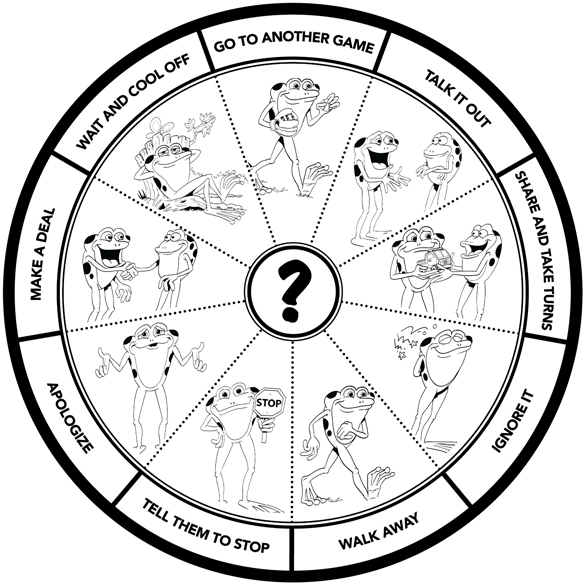
KELSO'S CHOICES: Solving small problems or conflicts.
Small Problems or Big Problems: What's the Difference
Small problems happen more often than big problems. Small problems are not scary, not dangerous, and no one will get hurt. Even though they are small, they can still make kids feel frustrated, annoyed, sad, or bothered.
When a small problem happens, students are encouraged to try to solve it on their own first before asking an adult for help. We want to help kids learn how to solve small problems by themselves. With practice and gentle reminders, students can learn healthy ways to work through conflicts.
Big problems are different. Big problems are scary, dangerous, or someone could get hurt. When a student experiences or sees a big problem, they should tell an adult right away..
If a student is not sure how big the problem is, we ask these questions:
- Is it scary?
- Is it dangerous?
- Could anyone get hurt?
If the answer is no to all of these questions, it is a small problem. The student can try up to two of Kelso’s Choices to solve it on their own.
If the answer is yes to any of the questions, it is a big problem, and the student should report it to an adult right away.
Conflicts or disagreements (small problems) are normal and often happen when children get together and interact. The goal of Kelso Choices is to teach students several positive ways to deal with these situations. To do this, we are asking students who have small problems to try at least two of the following choices:
- Go to Another Game
- Respectfully Talk it Out and listen to each other
-
Walk Away from the problem/situation
-
Ignore the problem or behavior
- Tell the person to Stop the problem behavior
- Apologize
-
Make a Deal or Compromise
- Wait and Cool Off
- Share and Take Turns
Kelso's Choices can be used with verbal or nonverbal responses. Words are not always needed to solve the problem. We hope this will help you at home as well. Families, siblings, cousins and more have small problems or conflicts at times. If you remind your children of these options for problem-solving, they will get more confident and become better at using these choices. You may even notice that they will need you less often for small problems.